
Vermont moves comprehensive chemical reform forward: Big win for public health
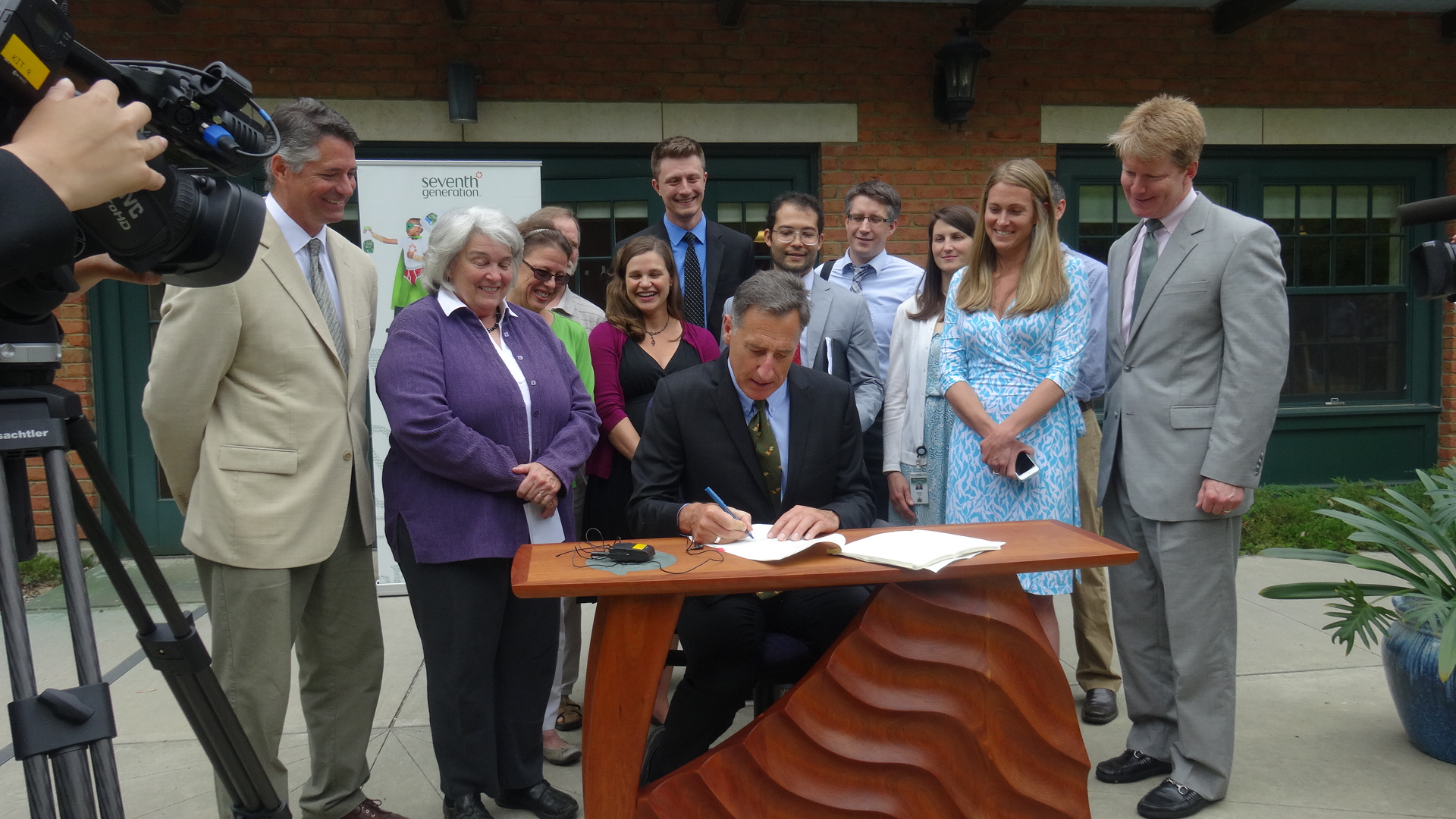
June 2014 - Joined by environmental groups, health care advocates, firefighters, sustainable business leaders and key legislators, Governor Peter Shumlin signed into law Act 239, a bill aimed at protecting children and families from toxic chemicals.
In partnership with the Alliance for a Clean and Healthy Vermont, VPIRG, the Vermont State Firefighters Association, VBSR, and Seventh Generation, Planned Parenthood of Northern New England worked diligently to move this important legislation forward. Act 239 is a necessary step toward ensuring that all Vermont families have piece of mind and adequate protection from harmful chemicals in the environment. Other states, including Maine, Washington and California, have already adopted similar programs and Vermont's program will utilize the progress made in these other states.
The link between toxic chemicals and reproductive health
As a trusted provider of health care to thousands of Vermonters every year, we’ve joined with other environmental and public health advocates in calling for comprehensive chemical reform because we see a clear and immediate risk to pregnant women, children and all Vermonters from unnecessary exposure. The American College of Obstetricians and Gynecologists and the American Society of Reproductive Medicine have recently issued a joint statement urging health care professionals to advocate for government policy changes to identify and reduce exposure to toxic environmental agents.
The statement, issued in September of 2013, stresses how "the scientific evidence over the last 15 years shows that exposure to toxic environmental agents before conception and during pregnancy can have significant and long-lasting effects on reproductive health" and calls on health care providers to support public policy that identifies and ultimately reduces exposure to toxic chemicals.
Attention has rightly been given to the effects of these toxic chemicals on infants and children. Exposure to the chemicals found in many kinds of consumer products has a critical impact on pregnant women and developing fetuses and babies Increased evidence over the last fifteen years has linked exposure to certain toxins to miscarriages and stillbirths, impaired fetal growth, pre-term births and birth defects. Ultimately, all people at any age are at risk and we will be voicing our concern to the advisory group that next steps need to take into account the broader population.
Our health care professionals routinely see patients with some of the health issues that we know have been linked to toxic chemical exposure and it is our duty as Northern New England's largest reproductive health care provider to do all that we can to protect our patients and their families.
Federal reform going nowhere
TSCA, the Toxic Substances Control Act, was passed in 1976 under President Ford. Though opponents of Act.239 would like you to think otherwise, federal efforts at updating the nation's primary law for regulating chemicals used in everyday products have not made much progress. Though TSCA does provide some basic protections in states with little to no regulation, it is desperately in need of an update with several outstanding inadequacies including:
- Puts the burden of proof on the consumers and government rather than manufacturers.- Allows manufacturers to keep secret the ingredients in certain chemicals
- Makes it difficult for consumers and businesses to identify which products have harmful chemicals
- Fails to motivate the chemical industry to steer towards safer chemical and product design
- Does not include chemicals introduced after 1976 when TSCA was enacted. Over 80,000 have been on the market and available since then.
There is broad consensus in Congress and even on the part of the chemical industry for federal reform but getting there is another story. In testimony to the VT House Committee on Fish, Wildlife and Water Resources, representatives from the offices of Senator Bernie Sanders, Senator David Vitter and Senator Boxer made it quite clear that nothing positive from Congress was likely to come out anytime soon in regards to federal law regulating toxic chemicals.
Though champions like the late Senator Frank Lautenberg and Senator Barbara Boxer as well as the EPA have stressed the need for meaningful legislation, anti-regulatory groups like the American Chemistry Council have tried to steer TSCA reform into a regressive direction that has the potential to roll-back progress made in certain states. The timeline or feasibility of meaningful federal reform is unclear and to push off legislation any longer on the state level would be a disservice to Vermonters.
What Act 239 does
S.239 ultimately holds manufacturers of products with harmful chemicals accountable and provides piece of mind to Vermont consumers. Eventually, it will lead to the discontinued use of known toxins in consumer products. Initially introduced in the VT Senate, the bill's aim was to bring a comprehensive approach to toxic chemical regulation rather than having to individually legislate on particular chemicals (see Tris bill from 2013). Implementation of a more comprehensive approach will ensure efficiency and science prevail in the regulating of toxic chemicals and that protections go into effect sooner rather than later.
Though the bill was limited in scope from all consumer products to just children's products, it does maintain the authority for the Vermont Department of Health to regulate known toxins and will essentially do the following:
- Establish a list of dangerous toxins still used in products (beginning with the list of chemicals of high concern to children currently in use in Washington State),
- Require manufacturers that sell children’s products containing one or more of those chemicals to report to the state and pay a small fee, and
- Give experts at the Vermont Department of Health the authority to regulate the toxins on the list that are used in children’s products
Special thanks & next steps
This bill wouldn't have been possible without the steadfast support and leadership from key legislators; namely Senator Ginny Lyons, Senator Claire Ayer, Senator Kevin Mullin and Senator Chris Bray, Representative Willem Jewett, Representative David Deen, Representative Jim McCullough, Representative Kate Webb, Representative Ann Pugh, Representative Dave Sharpe and Speaker Shap Smith. These individuals stood by the bill in the face of serious opposition and made sure action was not delayed in protecting vulnerable Vermonters. Additionally, the Vermont Department of Health and the Agency of Natural Resources played a key role in shaping this legislation moving it forward.
Over the next couple of years, stakeholders like Planned Parenthood of Northern New England, Seventh Generation, the League of Conservation Voters and VPIRG will be working with the Department of Health in educating Vermonters about the program and working to spread the word about the important link between toxins and environmental health. Be sure to check out the PPNNE Good Chemistry Blog for news you can use on how to protect you and your family from unnecessary exposure and for updates on the roll-out of the toxic exposure prevention program in Vermont.
All Vermonters should be guaranteed that their own efforts to stay healthy aren't undermined by exposure to toxins they aren't even aware of. This bill is a necessary step forward because it addresses toxic chemical exposure in an efficient manner and allows for adequate stakeholder input. A safe environment, free of harmful chemicals, is critical to the health and welfare of all Vermonters.
Read more...
http://digital.vpr.net/post/toxics-bill-resurrected-after-snafus-nearly-spell-doom
http://vtdigger.org/2014/05/09/toxic-chemicals-bill-passed/
http://www.csrwire.com/press_releases/37049-Seventh-Generation-Congratulates-Vermont-Government-on-Passing-Bill-S-239-for-Toxic-Substances-Reform